


FARIDABAD: The Cyber Investigation Agency (CIA) is committed to strengthening India’s cyber defense ecosystem by adopting emerging technologies, fostering innovation, and empowering enforcement professionals with cutting-edge digital tools. As part of this mission, the CIA is proud to highlight DARC – Deepfake Analysis and Reliability Classifier (www.darcai.net), an Artificial Intelligence–based platform designed to determine whether an uploaded image is genuine or artificially generated (deepfake).
Developed by Ms. Siya Singh, a Class XII student and promising young innovator, DARC represents a significant step forward in combating digital misinformation, identity misuse, and cyber-enabled fraud.
🧠 What is DARC?
DARC (Deepfake Analysis and Reliability Classifier) is a web-based AI tool that:
- Analyzes uploaded images in real time
- Determines whether the photo is original or altered/generated
- Provides a reliability score
- Helps identify synthetic or AI-driven digital impersonation
As deepfake technology becomes more accessible, enforcement agencies, financial institutions, and digital platforms face new challenges. Tools like DARC help law-enforcement officers verify identity, validate documents, and prevent forgery-based cybercrime.

🏛️ DARC Presented During CIA Cyber Training – NACIN (CBIC)
As part of CIA’s high-level training program for enforcement officers, DARC was introduced during the Cyber Crime and Technology-Enabled Financial Fraud workshop at NACIN – National Academy of Customs, Indirect Taxes & Narcotics, India’s premier training institute under CBIC, Ministry of Finance.
During the session, CIA trainers demonstrated how DARC can assist officers in detecting:
- Fake identity documents submitted during GST registrations
- AI-generated impersonation used in fraudulent invoices
- Social-engineering schemes involving fake victim photographs
- Misuse of deepfake content for extortion or coercion
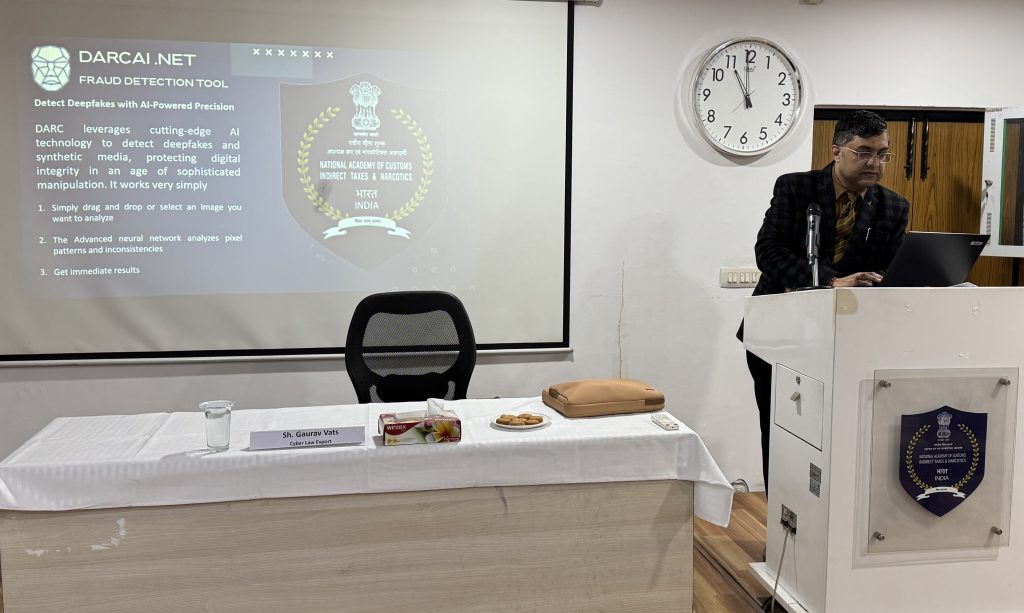
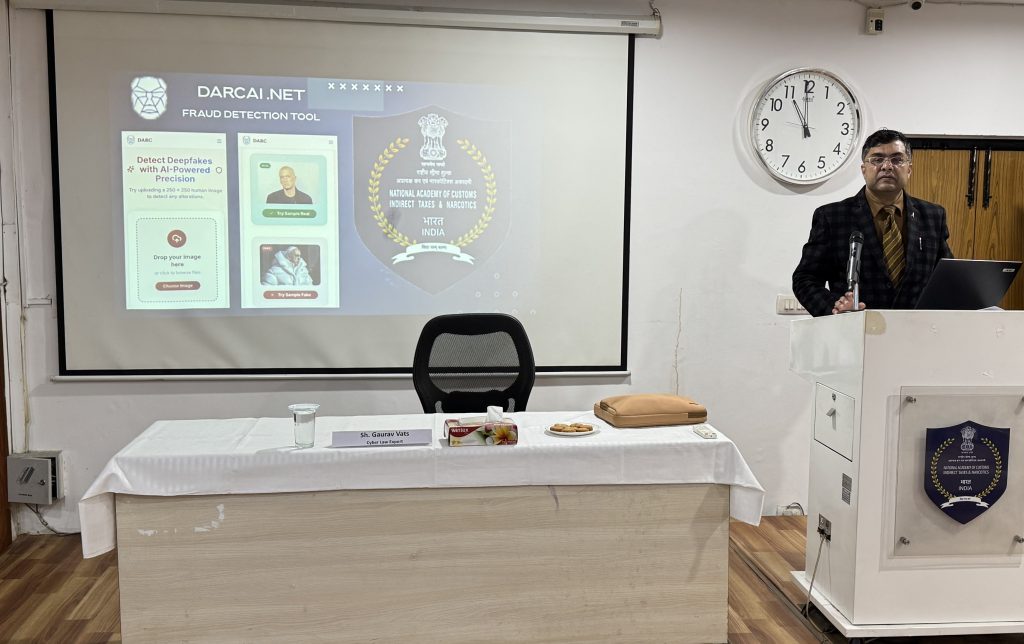
“CIA Trainer presenting DARC deepfake-detection module to batch of Customs & GST officers at NACIN Headquarters.”
This inclusion of DARC in an official training environment marks its first exposure to national-level enforcement professionals, validating both its technical merit and practical application.
🏅 Youth Innovation Recognized
CIA extends formal appreciation to Ms. Siya Singh for conceptualizing and developing DARC while still in Class XII. Her contribution demonstrates that young innovators can directly support national cyber defense priorities.
A formal Appreciation Certificate has been issued to Siya and linked to this page for verification.
A QR Code printed on her certificate leads directly to this webpage, serving as public proof of acknowledgment.
🛡 DARC in Enforcement – Why It Matters
Deepfake-based scams are rising across India and globally. Criminals now use AI-fabricated photos to:
- Create fake ID proofs
- Impersonate taxpayers
- Generate false KYC documentation
- Commit digital extortion
- Manipulate public perception
Tools like DARC offer a first-layer screening mechanism that GST, Customs, Police, and Cyber Cells can use alongside formal forensic workflows.
CIA intends to continue evaluating DARC for structured integration in enforcement environments and to encourage similar young-inventor solutions.
🤝 CIA’s Role in Supporting Youth-Driven Cyber Tools
This initiative reaffirms CIA’s commitment to:
✔ Encouraging student-built cybersecurity technologies
✔ Bridging innovation with on-ground enforcement
✔ Highlighting Indian youth talent on global platforms
✔ Supporting academic advancement & research motivation
Young innovators like Siya set a powerful example of how technology and social responsibility can intersect, contributing to cyber safety across the country.
📎 Letter & Verification
For authenticity and academic records, US universities and institutions may verify the award issued to Ms. Siya Singh by scanning the QR code printed on her certificate, which redirects to this exact page.
👉 If you are a university or admissions official needing confirmation, please contact:
📧 [email protected]
📞 +91-995-8888-555
📣 Call to Action
🚀 Are you a student innovator developing cybersecurity tools?
CIA welcomes collaboration and pilot testing opportunities.
Email us at: [email protected]

Mumbai: On Tuesday evening, a bold robbery unfolded at a Ghatkopar jewelry store, orchestrated by two young men who successfully made off with a gold chain by feigning a failed UPI payment. Initially deceived, the shopkeeper, upon realizing the absence of the transferred money, attempted to pursue the culprits, but they quickly fled on their motorcycle.
Clever Criminals: Entering the store, the duo appeared to have an interest in purchasing a gold chain. One of them tested the chain and indicated a desire to buy it. The store owner then prepared the receipt and provided the UPI scanner for payment.
Connection Glitch: Alleging a network problem, one of the individuals stepped outside with his phone, purportedly to facilitate the money transfer. The shop owner, recalling the incident in the FIR, stated, “He took my phone number and assured me of making the payment.

Deceptive Message: Shortly thereafter, the store owner received a text message from an unfamiliar mobile number confirming a payment of Rs 24,500, precisely the amount for the chain. The shopkeeper, without realizing it was not a valid bank notification, returned and showed me the message.
Nabbed in the Act: Assured of receiving payment, the store owner was on the verge of handing over the chain when he discovered that the money had not been credited to his bank account. Upon interrogating the individuals, they hastily fled the shop, taking the chain with them.
Unsuccessful Pursuit: The individual made an effort to pursue the young men, who swiftly vanished on their bicycle. A police officer reported, “We possess CCTV footage capturing their departure.” A formal complaint has been registered at the Ghatkopar police station.
Holiday Deception: This occurrence serves as a clear reminder of the importance of staying vigilant during the holiday season, a time when scams and fraudulent schemes tend to be more widespread. Both retailers and customers should exercise caution when dealing with potentially dubious transactions and ensure careful verification of all payments before exchanging valuable items.
Stay Alert, Stay Safe: This case highlights the importance of:
- Verifying bank notifications.
- Always check if a payment confirmation comes directly from your bank, not an unknown number.
- Not handing over valuables until payment is confirmed.
- Don’t rely solely on messages or verbal claims of payment.
- Reporting suspicious activity immediately
- Inform the authorities promptly in case of any fraudulent attempt.
- By remaining vigilant and adopting safe practices, we can deter such crimes and ensure a secure and joyful festive season.
Cybercriminals are expanding their reach in India, employing a new tactic to target unsuspecting citizens through text messages. The Indian Computer Emergency Response Team (CERT-In) has issued a proactive warning against “smishing,” a form of phishing conducted through SMS.
In a recent communication via X (formerly Twitter), CERT-In urged the public to exercise caution, alerting them to the risks of “smishing attacks.” This term, derived from ‘SMS phishing,’ refers to a manipulative scheme wherein individuals are tricked into revealing sensitive personal or financial information or engaging in financial malfeasance.
Understanding Smishing:
Smishing, a fusion of “SMS” and “phishing,” entails sending deceptive text messages that masquerade as legitimate communications from sources such as banks, government agencies, or well-known brands. These messages often create a sense of urgency, compelling recipients to click on malicious links, disclose sensitive information, or execute financial transactions.
Modus Operandi:
Smishing scams employ persuasive tactics, with messages that may:
- Threaten negative consequences: “Your bank account will be blocked if you don’t update your details!”
- Offer enticing deals: “Win free gifts by clicking this link!”
- Masquerade as official communications: “Important KYC update needed for your Aadhaar card!”
Once victims click on the provided link, they may be directed to fraudulent websites designed to steal personal information, install malware, or initiate unauthorized transactions.
Staying Safe:
CERT-In recommends the following precautions to avoid falling victim to smishing scams:
- Exercise caution: Refrain from clicking on suspicious links in text messages or social media posts.
- Verify shortened URLs: Use online tools to check the legitimacy of shortened URLs before clicking.
- Be skeptical: Legitimate institutions rarely request sensitive information via text message.
- Update defenses: Employ updated antivirus and antimalware software.
- Double-check senders: Verify any suspicious messages by contacting your bank or institution directly.
- Use separate accounts: Maintain separate personal and online transaction accounts for enhanced security.
- Enable MFA: Implement multi-factor authentication for emails and bank accounts.
- Stay patched up: Keep operating systems and software updated with the latest security patches.
Reporting Cybercrime:
If you come across a suspicious text message or suspect you’ve been targeted by a smishing scam, report it to CERT-In:
- Call the helpline: 1930
- Visit the official website: cybercrime.gov.in
By staying informed and vigilant, you can shield yourself from smishing scams, safeguarding your personal information and finances. Remember: If a text message appears too good to be true, exercise caution to prevent cybercriminals from compromising your hard-earned money and personal data. Stay aware, stay safe!

Swift Action by Uttarakhand STF and Police, Assisted by Meta’s Alert System, Averts Potential Suicide
In a prompt response on December 18, the Uttarakhand Special Task Force (STF) and Udham Singh Nagar Police, leveraging Meta’s alert system, prevented a potential suicide in the district.
The incident came to light when a man named Sachin (name changed) posted a distressing message on Instagram, indicating suicidal intentions. Thanks to Meta’s proactive monitoring of online platforms, the information reached the Uttarakhand STF’s cyber police station.
Deputy Superintendent of Police (DSP) Ankush Mishra, designated as the nodal officer for such cases, quickly contacted Additional Superintendent of Police (ASP) Bir Singh and DSP Anusha Badola of Udham Singh Nagar. A police team was dispatched immediately to the location identified in the post.
Upon arrival, the officers found Sachin, distressed by personal difficulties, had posted the suicide message in a state of confusion. Fortunately, he was unharmed and was safely handed over to his family.
Senior police officers provided counseling and support to Sachin, who assured them he wouldn’t repeat such an act.
Meta, the parent company of Facebook, Instagram, and WhatsApp, employs a comprehensive approach to detect potential suicidal content and distress signals on its platforms.

Key Elements of Meta’s Approach:
- Automated Detection Systems:
- Pattern Recognition: Algorithms scan text, captions, and comments for keywords, phrases, and emojis associated with suicidal ideation.
- Image Analysis: AI systems analyze images and videos for cues indicating self-harm or suicidal intent.
- Behavioral Changes:
- Sudden changes in posting frequency, engagement patterns, or direct messages mentioning suicide trigger alerts.
- User Reporting:
- Users can flag posts or messages expressing suicidal intent, triggering human review by trained content moderators.
- Human Review and Intervention:
- Trained content moderators assess flagged content and reported concerns, taking various actions based on severity.
- Collaboration and Research:
- Meta collaborates with suicide prevention experts and mental health professionals to refine detection algorithms and intervention strategies.
- Collaboration with law enforcement agencies ensures swift and appropriate action in critical situations.
Continuous research and development efforts aim to improve the accuracy and effectiveness of Meta’s suicide prevention measures.
While acknowledging that no system is perfect, Meta’s efforts highlight the potential of technology and collaboration in suicide prevention.
In case of suicidal thoughts, seek help from suicide prevention hotlines, mental health professionals, or trusted friends and family. This incident emphasizes the vital role of technology and cooperation in addressing online threats and mental health concerns.

NOIDA: HCL Technologies, a prominent Indian IT conglomerate, has revealed a ransomware attack affecting a specific project in an isolated cloud environment. The company has promptly initiated a thorough investigation and assured stakeholders that its broader network remains secure.
Manish Anand, HCL Tech’s secretary, stated in a filing to the National Stock Exchange of India, “We are aware of a ransomware incident in an isolated cloud environment associated with one project. There has been no observed impact on the overall HCL Tech network. Cybersecurity and data protection remain our top priorities.”
With over 225,000 employees across 52 countries and $13 billion in fiscal 2023 revenue, HCL Tech joins the growing list of Indian corporations targeted by cyberattacks in 2023. Sun Pharmaceuticals faced a data breach in March, while Tata Power experienced a cyberattack impacting its power business in October 2022.
Ransomware, a form of malicious software that encrypts files and demands ransom for decryption, continues to pose a significant threat to organizations worldwide. India’s Computer Emergency Response Team (CERT-In) reported a 53% increase in ransomware attacks against Indian institutions in 2022.
Organizations are strongly advised to remain vigilant and adopt robust cybersecurity measures, including regular backups, software updates, strong security software, and cautious online behavior.
In a separate alarming development, footage of Insomniac Games’ highly anticipated Wolverine title surfaced online following a data breach. The Ryhsida ransomware group claimed responsibility, disclosing 1.67 terabytes of stolen data on December 12th.
The leaked information includes intricate details about Wolverine’s level design and character assets, along with confidential internal presentations outlining future projects from Insomniac and Sony. These leaks encompass plans for an X-Men game trilogy, a future Spider-Man title, and entries in the Venom and Ratchet & Clank franchises.